
In hydraulic systems, pressure is a core parameter. Due to factors such as the historical measurement systems of different countries and regional industrial standards, a variety of pressure units are in use. This article will help you understand the pressure units MPa, PSI, and Bar.
What Does MPa Stand for in Pressure?
The term “MPa” frequently seen on hydraulic lines stands for megapascals—a unit of pressure within the International System of Units (SI).MPa is a unit of measurement for pressure and stress. Pa (Pascal) is the unit of pressure in the International System of Units (SI).
1 MPa = 1,000,000 Pa
1 MPa = 10 Bar
1 MPa ≈ 145.04 PSI
1 MPa = 1 N/mm²
Hydraulic systems typically involve high operating pressures.MPa provides a concise way to represent large pressure values.MPa is frequently used in the specifications for industrial equipment, hydraulic pumps, valves, and hydraulic hoses.MPa is a common unit of pressure found in international engineering and industrial technical documentation.
What Is PSI in Pressure Measurement?
PSI stands for “pounds per square inch.” It is a unit of pressure commonly used in Western countries—for instance, to measure air pressure in vehicle tires or the pressure within hydraulic cylinders. In the automotive industry, PSI is frequently used to specify pressure levels, such as in tire inflation or engine oil pressure.
PSI = Pounds per Square Inch.
In Chinese, this is “pounds per square inch.”It is a unit of pressure in the imperial system.
It is primarily used in the United States and other markets that employ imperial units.
In North America, PSI is commonly used for hydraulic and industrial equipment.
Many hydraulic hose catalogs and technical specifications utilize PSI.
International suppliers often provide specifications in both PSI and MPa to ensure clarity for customers across different regions.
What Is Bar?
The bar is a common unit of pressure.
It is widely used in industrial equipment, pneumatic systems, and hydraulic systems.
1 Bar = 100,000 Pa.
Conversion Relationships Between MPa, PSI, and Bar Units
There is a fixed conversion relationship between MPa and PSI.
MPa to Bar: 1 MPa = 10 Bar
MPa to PSI: 1 MPa ≈ 145 PSI
Bar to PSI: 1 Bar ≈ 14.5 PSI
Is MPa Higher Than PSI?
MPa and PSI are different units of pressure; it is not a matter of which one is “higher.” The same pressure can be expressed using different units.
| Unit | Full Name | Measurement System | Common Usage |
| MPa | Megapascal | SI / Metric | Hydraulic systems |
| PSI | Pounds per Square Inch | Imperial / US customary | US hydraulic equipment |
| Bar | Bar | Metric-based | Industrial equipment |
Such as:
1 MPa ≈ 145 PSI
10 MPa ≈ 1,450 PSI
20 MPa ≈ 2,901 PSI
30 MPa ≈ 4,351 PSI
Which Is Better for Hydraulic Hose Pressure Ratings: MPa or PSI?
Both can be used to denote pressure ratings; the key is to understand unit conversions and to verify which type of pressure parameter the manufacturer has provided.
MPa to PSI to Bar Conversion: How to Convert Pressure Units
The conversion between the pressure units of MPa, PSI, and Bar
Pressure unit conversions are typically difficult for those who work in the hydraulics and industrial fluid industries since the terms MPa, PSI, and bar are used differently by machine builders from around the world, and to comply with regional standards and conform with the labeling on your equipment. The improper understanding of pressure units could cause over pressurization, the breaking of a hydraulic hose or a failure in one of your components. The risk is greatly increased when you are sourcing hydraulic hose, fittings, valves or pumps from overseas suppliers.
Engineers, technicians, maintenance workers, and purchasing agents will be able to correctly read specifications for products, results of experiments, and labels on machinery after mastering different ways of converting things to pressure.
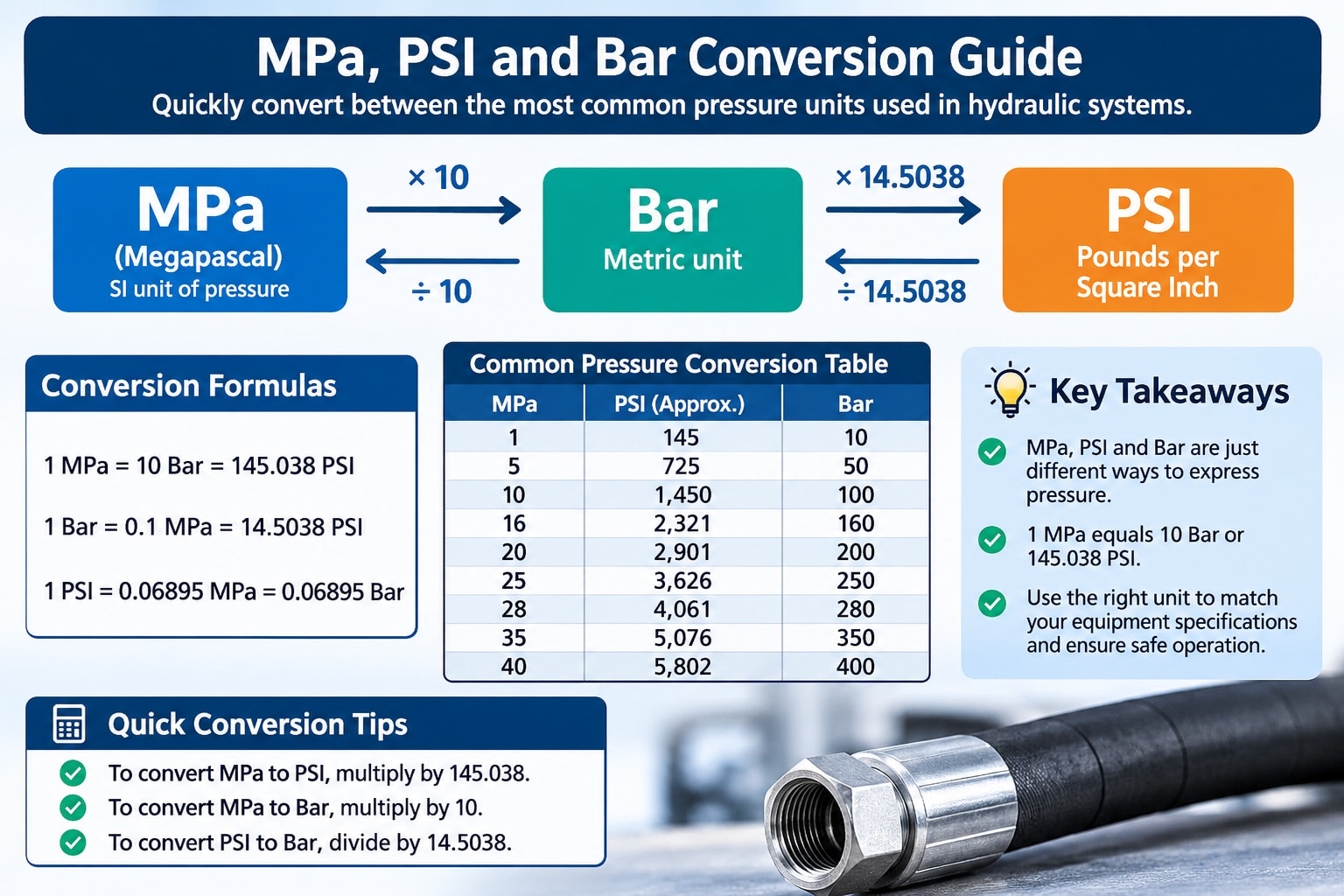
MPa to PSI to Bar Conversion Chart
MPa to PSI Conversion Formula
PSI = MPa × 145.038
MPa to Bar Conversion Formula
Bar = MPa × 10
PSI to Bar Conversion Formula
Bar = PSI ÷ 14.5038
Standard Conversion Formulas
The following conversion ratios are widely accepted for hydraulic applications:
1 MPa = 10 Bar ≈ 145 PSI
1 Bar = 0.1 MPa ≈ 14.5 PSI
1 PSI ≈ 0.06895 Bar ≈ 0.006895 MPa
Note: In everyday hydraulic product quotations and labeling, most manufacturers use the rounded-off approximate values shown above. However, for high-precision pressure testing or fatigue strength calculations, please ensure that you use the exact, high-precision decimal values.
Hydraulic Pressure Conversion Table
| MPa | PSI (Approx.) | Bar |
| 1 | 145 | 10 |
| 5 | 725 | 50 |
| 10 | 1,450 | 100 |
| 16 | 2,321 | 160 |
| 20 | 2,901 | 200 |
| 25 | 3,626 | 250 |
| 28 | 4,061 | 280 |
| 35 | 5,076 | 350 |
| 40 | 5,802 | 400 |
Practical Tips for Hydraulic Industry
Start by getting into the routine of checking the product nameplate for dual markings. A good hydraulic supplier will list two or three pressure units right next to each other, so you’re less likely to make a conversion mistake.
Working pressure and burst pressure shouldn’t be lumped together. The conversion ratio stays the same, though, and you still need to keep those two values distinct.
When you replace imported hydraulic parts, don’t start with fit or form. First, line up the pressure unit you see on the original gauge with the pressure unit on the host machine. If you get that unit wrong, it’s one of the top reasons hydraulic hoses end up failing.
When your customers are spread across regions, put pressure values in your datasheets in both metric and imperial units, so they can talk to each other without all the usual back-and-forth.
Quick Examples of Pressure Conversion in Hydraulic Applications
A hydraulic hose rated at 3,000 PSI is approximately 20.7 MPa.
A hydraulic system operating at 25 MPa requires components rated for the applicable operating pressure and pressure conditions.
Understanding Hydraulic Hose Pressure Ratings
The pressure rating of a hydraulic hose is a key parameter that must be verified when selecting a hose. It represents the maximum safe working pressure that a hose can withstand over the long term under standard operating conditions. This is distinct from “burst pressure” and “test pressure”—a distinction that field personnel most frequently confuse.
What Is the Working Pressure of a Hydraulic Hose?
A hydraulic hose’s working pressure, also called the maximum working pressure or rated operating pressure, is basically the top pressure the hose assembly can handle safely all the time, as long as you’re within the normal design conditions. You’ll see this figure on the hose itself and in the datasheet, and it’s also printed on the marking label. When you’re choosing hoses for a hydraulic system, that rating is the main one you should go by.
Working Pressure: Safe continuous operating limit for daily service.Working pressure (also called maximum operating pressure) refers to the highest continuous pressure that the hose or fitting can safely withstand under normal operating conditions. This rating is calculated with safety factors taken into account, considering repeated pressure cycles, fluid temperature, dynamic pressure spikes, bending and vibration during daily operation.
This rating is set and verified using global standards like SAE J517, EN 853, and ISO 1436. It’s not some guess about what happens in a single overload. Instead, it covers the kind of steady cyclic pressure you’d normally see, along with everyday pressure swings, assuming the hose is installed correctly and stays within its rated temperature range. So if you see a hose listed as 3000 PSI / 207 bar working pressure, that number is its safe continuous operating limit.
What Is the Burst Pressure of a Hydraulic Hose?
Burst Pressure: The pressure at which the hose ruptures in static lab burst testing.Burst pressure is the test pressure at which the hose assembly will rupture or leak when pressure is steadily raised in a static lab test. It is a destructive test index, not an operating parameter.
Many buyers mix up working pressure and burst pressure, and this mistake leads to premature hose failure or safety accidents.
What Is the Difference Between Working Pressure and Burst Pressure?
When selecting the hydraulic hoses, PTFE hoses, fuel hoses and hydraulic fittings, you will frequently see two critical pressure ratings marked on product datasheets and hose labels: working pressure and burst pressure. These two values are not interchangeable, and confusing them is one of the top causes of hose failure, leakage and safety accidents in fluid power systems.
| Parameter | Working Pressure | Burst Pressure |
| Meaning | Maximum rated operating pressure | Pressure at which the hose fails in a burst test |
| Purpose | Normal operation | Safety and design verification |
| Usage | Hose selection | Understanding safety margins |
| Application | Continuous service within rated limits | Not an operating target |
What Is the Safety Factor of a Hydraulic Hose?
Working Pressure vs Burst Pressure: The 4:1 Safety Factor
Both SAE and EN standards require a minimum safety ratio of 4:1, meaning burst pressure has to be at least 4 times the working pressure.
This value is used by manufacturers for quality verification and performance testing only. A hose must never be operated near its burst pressure. Once the internal pressure approaches this rating, the reinforcement structure will fail suddenly, leading to violent hose burst.
Take an SAE 100R2 hose that’s rated for 4000 PSI working pressure. Its minimum burst pressure is 16000 PSI.
Quick reminder: don’t choose a hose by its burst pressure. Burst pressure is just a quality check, not something you can treat as the allowed operating pressure. And even if it doesn’t fail right away once it goes over its working pressure, you can still end up with damage inside the inner tube and the steel reinforcement. That kind of hidden wear builds up and will cut the service life hard.
Key Factors That Change the Effective Working Pressure
The working pressure shown on the printout only applies when you’re using standard reference conditions. In real use, other field factors can reduce the pressure you should regard as safe, so the actual safe pressure will be derated:
- Operating temperature: As hydraulic oil gets hotter, it softens rubber compounds and makes the reinforcement less effective. For that reason, most rubber hydraulic hoses need a pressure derating when they run above the temperature range the manufacturer recommends. PTFE hoses are different: they keep their pressure ratings stable at much higher temperatures than standard rubber hoses.
- Impulse and pressure spikes: Frequent shock pressure, valve switching surges, and cyclic impulse loading. When your system throws off regular pressure spikes, pick a hose whose working pressure rating has some margin above the system’s peak pressure. For dynamic hydraulic jobs like excavators, loaders, and other construction machinery, impulse test results matter a lot.
- Hose inner diameter and reinforcement structure: Even within the same SAE series, hoses in different sizes are rated for different working pressures. Steel wire braided lines (1SN, 2SN, R1, R2) and spiral reinforced ones (R12, R13) show clear pressure differences. Spiral hydraulic hoses are built for ultra-high working pressure and heavy impulse duty.
- Installation quality: Installation details can quietly cut the hose’s dependable performance. Going past the minimum bend radius, twisting the hose, crimping the fittings improperly, or letting abrasion damage it can all do that, even when the system pressure remains under the printed rating.
Common Hydraulic Hose Pressure Ratings in MPa and PSI
Hydraulic hose pressure rating is one of the big safety knobs for keeping a hydraulic system running. You’ll see working pressure listed in MPa, bar, or PSI, depending on where the hose is made and what measurement conventions that region and manufacturer stuck with. When you’re picking hoses for a project, make sure the pressure unit and the rating line up with what your system needs, because the wrong match can lead to hose bursts, leaks, and expensive hydraulic failures.
Below is a quick look at the pressure ratings people commonly use for standard hydraulic rubber hoses, like SAE 100 R1, R2, R12, R13, R15, and a few other well-known grades. You’ll see the numbers in both MPa and PSI, so it’s easy to match across different markets.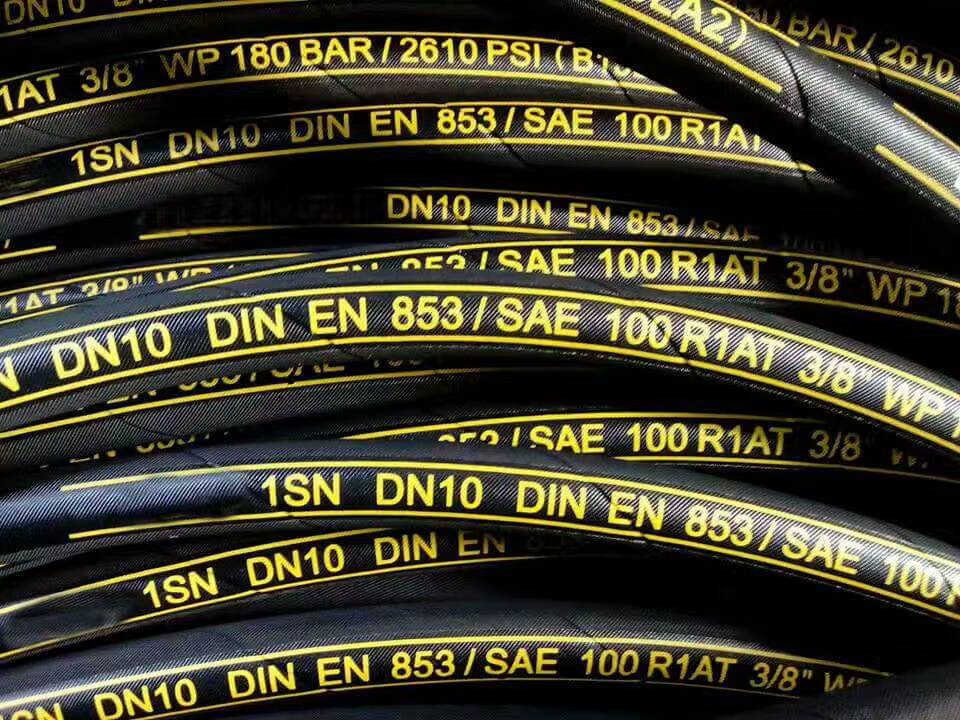
Note: the numbers given are maximum working pressure, not burst pressure. For standard hydraulic hoses that follow SAE requirements, burst pressure is usually about four times the working pressure. For the exact figures, rely on the official datasheet from your hose supplier.
| Hose Type | Working Pressure (MPa) | Working Pressure (PSI) |
| SAE 100 R1 | 10.5 MPa | 1520 PSI |
| SAE 100 R2 | 16.5 MPa | 2390 PSI |
| SAE 100 R12 | 28.0 MPa | 4060 PSI |
| SAE 100 R13 | 35.0 MPa | 5075 PSI |
| SAE 100 R15 | 42.0 MPa | 6090 PSI |
| SAE 100 R7 Thermoplastic | 21.0 MPa | 3045 PSI |
| SAE 100 R8 Thermoplastic | 28.0 MPa | 4060 PSI |
How to Choose the Right Hydraulic Hose Based on Pressure Rating
Match the Hose Working Pressure to System Requirements
Selecting a suitable hydraulic hose by pressure rating is one of the most critical steps to keep your hydraulic system safe and stable. A hose with insufficient pressure capacity may burst under load, leading to fluid leakage, equipment downtime and safety hazards. Overrated hoses, on the other hand, unnecessarily raise your procurement cost and complicate installation. Below we break down the key points for pressure-based hose selection.
Always make sure the hose’s maximum working pressure meets or exceeds the peak operating pressure of your hydraulic circuit. Do not use the burst pressure as your reference for normal operation.
Keep pressure spikes in mind. Many hydraulic systems generate transient pressure surges far above the steady working pressure when valves shift or cylinders actuate. These short spikes can damage hoses quickly if ignored. For systems with frequent pressure shocks, pick a hose with a higher safety margin.
For global projects, double-check pressure units. Specs may be marked in PSI, bar or MPa depending on standards and manufacturers. Avoid costly mistakes caused by unit conversion errors. We recommend hoses printed with dual pressure markings for cross-border applications.
Consider Hydraulic Hose Types and Pressure Ratings
Different reinforcement structures decide the pressure range of hydraulic hoses.
Wire braided hydraulic hoses (SAE 100 R1, R2): Common for medium-pressure general hydraulic lines. Single-wire braid suits lower pressure, while double-wire braid handles higher continuous pressure.
Spiral wire hydraulic hoses (SAE 100 R12, R13, R15): Designed for high-pressure and heavy-duty scenarios such as excavators, mining machinery and presses. Multiple spiral steel layers deliver excellent impulse resistance under cyclic pressure loads.
PTFE hoses: Offer stable pressure performance together with broad chemical resistance, ideal for high-temperature, corrosive fluid circuits.
Each hose series follows standard pressure tables. Never replace one hose type with another simply because the nominal size matches. Even with the same inner diameter, their working pressure and impulse life can differ greatly.
Consider Other Factors Besides Pressure
Pressure rating is the primary filter, yet it cannot be judged in isolation. You need to evaluate these parameters together before finalizing your selection:
- Hose inner diameter (ID):The bore size controls flow velocity. Too small an ID creates excessive backpressure, heat build-up and accelerated wear; oversized ID wastes space and budget.
- Operating temperature:Both fluid temperature and ambient temperature affect the hose’s pressure retention. Most rubber hoses lose working pressure rating at elevated temperatures.
- Fluid compatibility:Confirm the tube material is compatible with your hydraulic oil, biodegradable fluid or other media. Incompatible fluids will swell, crack the inner tube and cause premature failure.
- Bend radius: Installations below the minimum bend radius crimp reinforcement layers, reduce pressure resistance and shorten service life. Leave enough slack for movement and vibration.
- Abrasion resistance:Hoses routed against metal frames or exposed to rubbing need robust outer covers to prevent cover wear and steel wire exposure.
- Environmental conditions:UV exposure, ozone, salt spray and extreme cold all degrade rubber covers. Outdoor and offshore systems need specially formulated outer rubber.
- Applicable industry standards:SAE, EN and ISO specifications define test rules, impulse cycles and marking requirements. Match the standard to your target market for easier certification and acceptance.
Frequently Asked Questions (FAQs)
1.What’s the real difference between MPa and psi?
MPa and PSI are just two pressure units tied to different measurement systems. MPa is the metric SI unit, used a lot in Europe, China, and in most global ISO standards. PSI means pounds per square inch, which comes from the imperial system and shows up in North America, including under SAE hydraulic standards. Same underlying thing either way, pressure, but it’s coming from different industrial conventions. That’s why hydraulic manufacturers often print both MPa and PSI on a single hose when they’re selling to customers around the world.
2.On a hydraulic hose, what does “25 MPa” indicate?
This hydraulic hose is rated for a maximum working pressure of 25 MPa. In other words, it’s built to run continuously at 25 MPa as long as you stay within the recommended temperature and the right media. That 25 MPa figure is not the burst pressure. Don’t push the hose beyond its rated working pressure, because overpressure can cause swelling, leaks, or a sudden hose failure.
3.What’s the way to convert PSI into MPa?
If you need PSI in MPa, just take the PSI number and divide by 145. In other words: MPa = PSI ÷ 145. For example, 2900 PSI ÷ 145 comes out to 20 MPa. It’s a straightforward conversion that’s quick enough for on-site checking when you’re preparing a quote. Still, before you pair hoses with pumps, valves, or hydraulic circuits, double-check the pressure ratings.
4.Which pressure rating do I need to pick for a hydraulic hose?
Make sure the hose’s working pressure rating is at least as high as the maximum peak pressure in your hydraulic system, not only the normal pressure you see during routine running. It’s common industry practice to build in a proper safety margin. Don’t forget the spikes that can happen when the pump starts, when valves switch, and when loads hit suddenly. And always go by the hose manufacturer’s datasheet and the applicable hydraulic standards.
5.Does a higher MPa rating always mean the hydraulic hose is better?
Higher pressure ratings don’t automatically mean a hose is the best fit. In practice, going too high usually makes it heavier, stiffer, and more expensive. It can also come with a larger minimum bend radius, which may not work with a compact machine layout. So you have to weigh pressure rating against flexibility, size, weight, compatibility with the media, and your budget. Pick the rating that’s suitable, not the highest, because that’s what tends to give you the most reliable and cost-effective setup.
Conclusion:
Understanding MPa, PSI, and Bar helps you select the most suitable hydraulic hose more safely.
Looking for reliable hydraulic hoses for your industrial applications? Explore our range of hydraulic hoses with different pressure ratings, specifications, and constructions. Contact our team for technical support and product recommendations.